

Do you love your job?
Over the last two decades, the importance of job satisfaction has significantly increased (Esser & Lindh, 2018).
One of the main cornerstones of this development is a shift in perspective due to technological development (Johnson, 2024) and, of course, the COVID-19 pandemic. As a social psychologist, I have been watching this development with excitement.
People have become more intentional and purposeful about who they work for (Esser & Lindh, 2018). We care not only about creating work–life balance, but also about working for a company aligned with our beliefs.
In this article, we will explore different contributors to work satisfaction.
Why Job Satisfaction Matters for Mental Health and Wellbeing
The average person spends around 90,000 hours at work over their lifetime (Stoewen, 2016), making job satisfaction a key factor in overall wellbeing and mental health.
General studies on job satisfaction rates vary. Some report that anywhere from 30% to 82% of people are satisfied (Pew Research Center, 2024), while others suggest that about 77% of the workforce is disengaged at work (Gallup, 2024).
However, research on what creates job satisfaction and how it impacts companies is clear.
Companies that care for their employees’ wellbeing foster a positive work environment, resulting in higher employee retention rates and reduced turnover. Employees who are satisfied with their jobs are more motivated, engaged, and productive. They collaborate more effectively, which strengthens teamwork and shared success (García-Buades et al., 2019).
Job satisfaction has been linked to lower levels of depression and anxiety and may even reduce physical health issues like chronic pain, fatigue, and shortness of breath (Nur Aqilah & Juliana, 2012).
People who feel fulfilled at work are less preoccupied with physical symptoms and tend to experience greater overall life satisfaction and psychological wellbeing (Matud & Sánchez-Tovar et al., 2024).
Shawn Achor (2010) explains in his book The Happiness Advantage that positive emotions enhance brain function, boosting creativity and problem-solving skills. Positive emotions also enable people to feel safe (Fredrickson, 2001) and cultivate a growth mindset (Fredrickson, 2004).
Employees who are satisfied with their work benefit from mental clarity and increased focus, staying present and engaged in their roles (Shellow, 2022).
THIS IS WHAT MAKES EMPLOYEES HAPPY AT WORK
The hidden costs of dissatisfied employees
High levels of stress, burnout, and lack of engagement are associated with dissatisfied employees. As you can imagine, these aspects decrease productivity and increase absence, affecting both employees and organizations.
Job satisfaction isn’t just about feeling good at work. Motivation, increased health, and long-term employee success are the results of satisfied employees. Employees’ job satisfaction is directly linked to a company’s success.
Let’s dive into a few companies that focus on creating an employee base that thrives.
4 Real-World Examples of Workplaces With Satisfied Employees

So far, we have explored what improves job satisfaction. Now, let’s look at companies that regularly rank high when it comes to workplace satisfaction and what they have in common.
Buffer
Buffer is an excellent example of a successful remote work concept. Since 2015, the company has operated fully remotely with employees across 15 countries and 11 time zones.
It cultivates a culture that emphasizes communication and trust. Its policies, such as unlimited sick days (Gallani et al., 2017) and extensive resources, support a healthy work–life balance and are often celebrated.
Buffer is known for its expertise in virtual team-building activities. They regularly use the Employee Net Promoter Score, a job satisfaction survey, to measure their employees’ satisfaction levels. Buffer also assesses teams’ overall happiness levels on a regular basis (Miller, 2018).
Microsoft
Microsoft is another great example of a workplace that regularly scores high when it comes to employee satisfaction (Business Insider, 2025).
The company focuses on the employee experience within the company, as well as innovation and collaboration. Using these satisfaction metrics, Microsoft shifted from a culture of competition to a culture of collaboration, under the leadership of CEO Satya Nadella (Amazing Workplaces, 2024).
Communication and collaboration are central to a successful software development process (Johnson et al., 2019). To improve the exchange of information and effective teamwork, the company created new office layouts and better communication infrastructure.
Encouraging cross-functional teamwork and open communication fostered stronger relationships between employees.
Salesforce
Salesforce offers excellent compensation packages and benefits programs. It is known for its mentally stimulating work, an aspect that many employees report as an essential factor in job satisfaction.
Few companies provide the necessary support for employees to thrive while working on challenging tasks. Salesforce has created a working environment where employees can participate in initiatives that enable them to create work–life balance, reducing stress and contributing meaningfully (Salesforce, 2022).
Professional success is deeply connected to personal wellbeing. Salesforce has recognized the connection and created strategies that prioritize both. In 2022, they launched their Success From Anywhere Program, helping employees balance their personal and professional lives.
Through the B-Well Together Initiative, they have normalized mental health sessions with experts. They expanded their mental health offering beyond their employees and their families and even included their customers (Salesforce Careers, 2024).
Greener Field LLC
Other companies, such as Greener Field LLC (Tufegdzic, 2024), offer vacation compensation packages enabling employees to travel and explore the world.
Successful companies with satisfied employees often prioritize:
- Work–life balance and flexibility
- Employee wellbeing programs
- Employee recognition and fair compensation
- Collaboration and psychological safety
- Opportunities for growth and development
The Role of Leadership and Organizational Culture
We no longer live in an era in which employees stay in one company for the majority of their professional lives. It’s no longer just about being loyal to your employer. Trust and loyalty have to be earned. This is where leadership comes into play.
The phrase “People don’t leave organizations; they leave bad managers” is the single most significant reminder regarding the role of leaders and organizational culture. Organizations are made of people, and people shape organizational culture. Organizational culture is what enables people to experience job satisfaction.
WHY LEADERSHIP MAKES OR BREAKS EMPLOYEE SATISFACTION
Effective leadership is crucial in shaping job satisfaction by fostering a culture of trust, respect, and autonomy. Leaders who practice empathy, actively listen, and provide clear guidance create an environment where employees feel valued and motivated.
However, Kauppila (2025) suggests that there is a different side to how leaders are perceived. Job satisfaction often acts as a lens through which employees interpret their leaders’ behaviors.
It’s important to understand the different dynamics within organizations. Leadership can’t be successful if employees aren’t satisfied with their work. Unsatisfied employees can easily lead to burned-out leaders, and vice versa.
Different leadership styles influence people differently (Al-Owaidi et al., 2023). For example, self-actualized leaders are good at recognizing individual strengths and aligning roles according to team members’ talents. This promotes a sense of purpose and achievement.
Distributed leadership encourages collaboration and allows employees to take ownership of their contributions by sharing responsibilities across teams. Shared responsibility cultivates a sense of belonging, promotes positive relationships, and enhances overall job satisfaction (García-Buades et al., 2019).
GREAT LEADERSHIP IS A NETWORK, NOT A HIERARCHY - GITTE FREDERIKSEN
Overall, employees report higher job satisfaction when they consider their leaders to be supportive and understanding. They value guidance on managing their work effectively and emotional support (Al-Owaidi et al., 2023).
Employees also appreciate leaders who set clear performance expectations and provide constructive feedback on how they can improve (Edmondson, 1999).
Studies have also shown that leaders who enable employees to make their own decisions and involve them in the decision-making process increase job satisfaction and make the team members feel valued, which increases their commitment to their work (Prentice, 2022).
Ultimately, organizations that prioritize strong leadership and an inclusive culture are more likely to retain engaged, productive, and fulfilled employees.
Does Remote and Hybrid Work Improve Work Satisfaction?

During the pandemic, many companies had to switch to a remote work concept, and while some have been switching back, many are still offering hybrid or fully remote models.
Research on remote work produced mixed findings regarding job satisfaction. Some employees enjoy increased flexibility and shorter commutes. Others struggle with feeling isolated and lack work–life boundaries (Bloom et al., 2023).
Combining remote and in-office work offers a good balance between autonomy and social interaction, which can enhance overall job satisfaction (Bloom et al., 2023).
Factors such as organizational support, effective communication, and tech infrastructure are key to ensuring that team members working remotely are successful (Salesforce, 2021).
Employees who feel supported by and connected to their teams report higher satisfaction (Shore et al., 2011). Although more studies are needed to explore this topic in depth, when remote and hybrid work models consider employee needs and organizational goals, they could significantly improve overall satisfaction.
Diversity, Equity, and Inclusion + Job Satisfaction
According to the PEW Research Center (2023), about 56% of workers agree that it is good to focus on increasing diversity, equity, and inclusion (DEI). About 28% are impartial, and 16% are against DEI measures.
These results differ along demographic and partisan lines (Pew Research Center, 2023). This may indicate a misunderstanding of the terms diversity, equity, inclusion, and belonging, especially when we consider that trust, fairness, and respect are significant markers for job satisfaction.
Diversity
A comprehensive review published by Gomez and Bernet (2019) found that increased diversity within organizations leads to improved risk management. Diversity also fosters team cohesion, creating a positive dynamic that leads to higher engagement and decreases turnover rates.
Additionally, a diverse workplace fosters a sense of psychological safety, which enables people to express themselves without the fear of being judged or discriminated against. This, of course, increases job satisfaction and overall wellbeing (Edmondson, 1999).
Additionally, diverse teams practice a culture of acceptance, which makes employees feel valued and respected. This leads to a stronger sense of belonging (Shore et al., 2011).
Equity
Colquitt (2001) found that employees who perceive their employer as fair regarding promotions, pay, and career opportunities experience higher job satisfaction.
The same goes for employees who feel included and valued (Shore et al., 2011). The understanding of fairness is created through trusting that the organization will be equitable and just in their employee management.
Inclusion
Employees report higher satisfaction when they feel supported by their colleagues and when the organizational culture is inclusive and respectful. They also report lower stress levels (Shore et al., 2011).
A key aspect of inclusion is psychological safety, which has been linked to higher engagement, innovative thinking, and better job performance (Edmondson, 1999).
Especially effective inclusion models impact employees’ sense of belonging and respect by creating the feeling that their different viewpoints matter (Shore et al., 2011).
Job satisfaction through belonging
Belonging is the result of effective DEI strategies. When people feel like they belong, their sense of satisfaction increases because they are more engaged, innovative, and committed.
Job satisfaction increases overall through effective diversity, equity, and inclusion strategies. These umbrella terms incorporate what many employees describe when referring to what impacts their satisfaction.
THE JOB SATISFACTION WHEEL
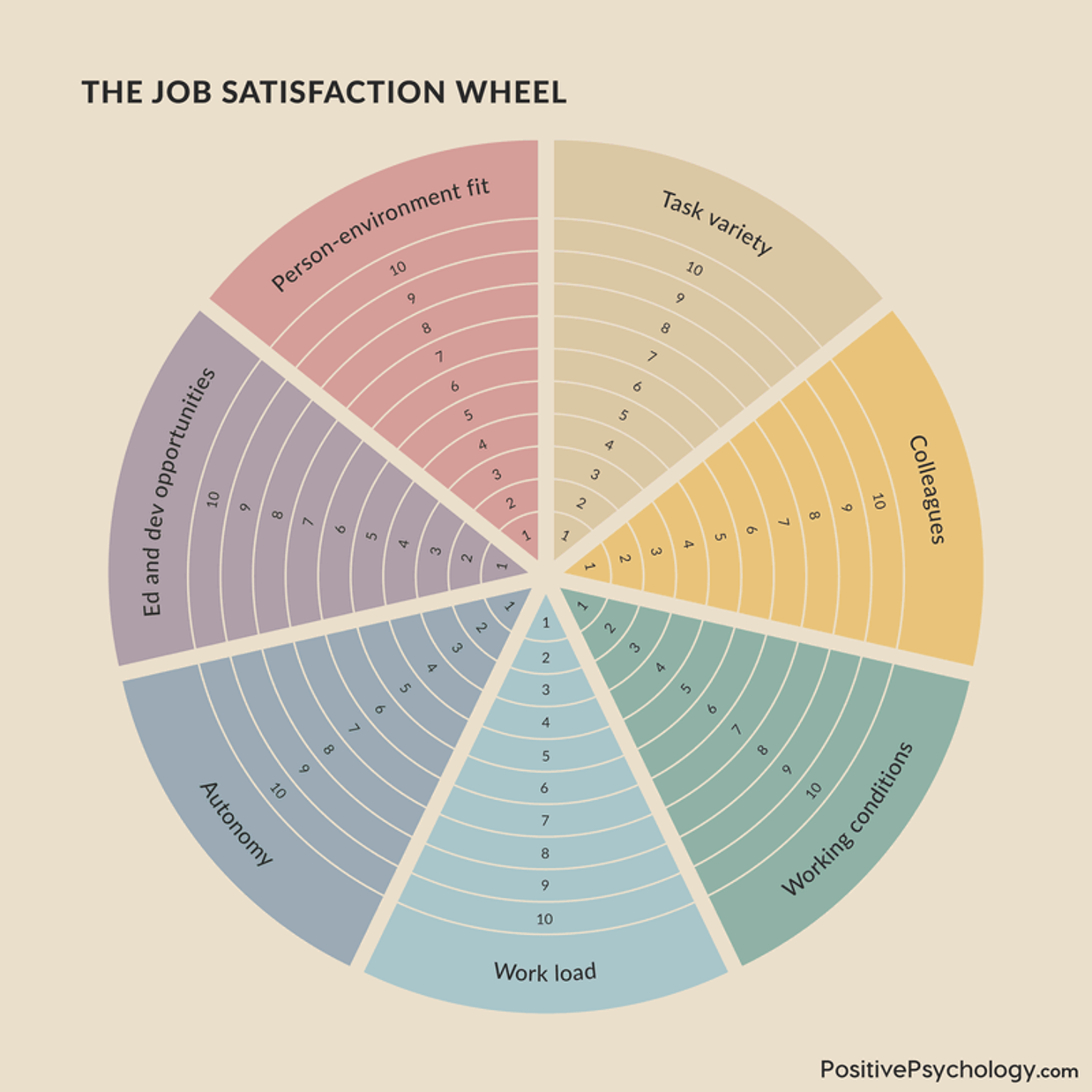
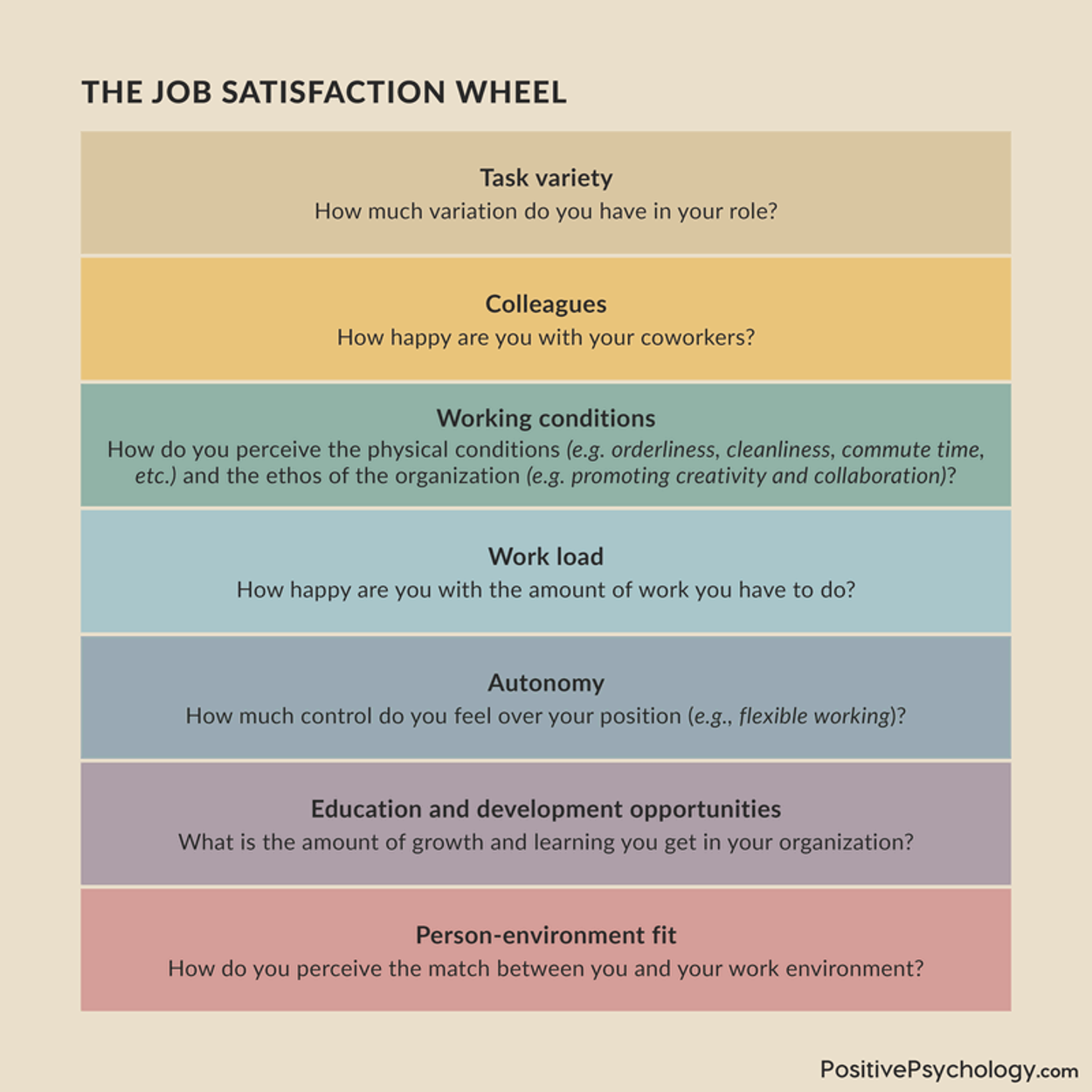
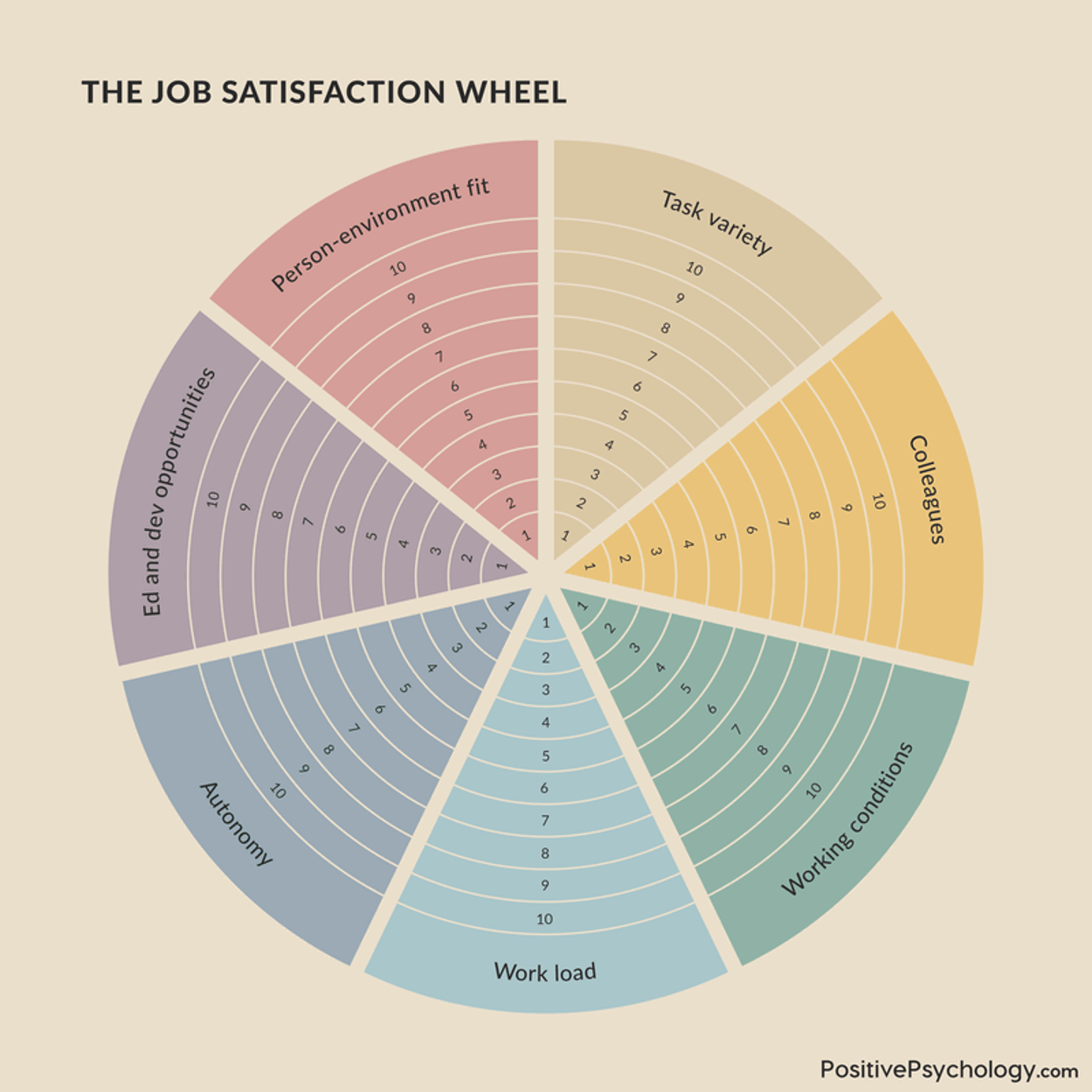
The Job Satisfaction Wheel can help assess your current job satisfaction and identify improvement areas. Job satisfaction measures subjective wellbeing at work (Judge & Klinger, 2008).
According to Roelen et al. (2008), there are seven key indicators of job satisfaction:
- Task variety
- Colleagues
- Working conditions
- Workload
- Autonomy
- Education and development opportunities
- Person-environment fit
Here’s how you can use the Job Satisfaction Wheel:
- Rate the seven job satisfaction domains on a scale from one – “not at all satisfied” to ten – “completely satisfied”. Place a circle around each score on the wheel.
- Connect your scores by drawing a line and forming an inner wheel. This gives you an overview of how satisfied you are with your current job.
- Looking at the wheel, where do you see areas for improvement? What would it take to improve the score? Which action steps can you take?
Interventions to Enhance Occupational Wellbeing
What practical approaches can your company implement to enhance occupational wellbeing?
1. Counseling services
Initiatives such as counseling services (Salesforce Careers, 2024) and vacation travel assistance increase overall wellbeing (Tufegdzic, 2024).
2. Interest groups
Support and shared interest groups provide safe spaces and build cohesion and belonging (Welbourne et al., 2017).
3. Travel
Greener Field LLC’s travel program enables employees to go away on a vacation. They encourage employees to be exposed to different cultures and foster an open mindset (Tufegdzic, 2024).
4. Gratitude
Supporting employees in practicing gratitude is an intervention that can increase job satisfaction. Some companies offer annual gratitude stipends that allow employees to do a random act of kindness by paying, for example, for a meal for a stranger or groceries (Tufegdzic, 2024).
5. Leadership development
Other initiatives include leadership development that trains managers to lead with empathy and gives them tools to support their teams effectively.
6. Reimbursements for healthy activities
Several companies offer reimbursement for sports activities, including gym membership, creating a holistic approach to overall wellbeing.
Now that we’ve explored the different initiatives that successful companies such as Microsoft and Buffer have rolled out, let’s explore more in-depth specific positive psychological interventions that can increase employee job satisfaction.
Positive psychology interventions
One of my favorite positive psychology interventions is the strengths-based approach, which supports employees in identifying their natural strengths and applying them at work.
The VIA Character Strengths Survey is a wonderful tool that enables employees to raise awareness of their signature strengths. Once they’ve identified their strengths, aligning those to work tasks can increase confidence, job satisfaction, and overall engagement at work (Seligman et al., 2005).
Mindfulness exercises such as mindfulness meditation (Achor, 2010), walking in nature, or breathing exercises are wonderful tools to help employees reduce stress and manage emotions (Ma et al., 2022).
Job crafting can increase the sense of fulfillment by allowing employees to shape and align their roles with their interests, values, and strengths, which improves job satisfaction (Wrzesniewski & Dutton, 2001).
Lastly, companies should provide positive feedback to ensure employees feel recognized and connected.
The Impact of Gender Differences on Job Satisfaction

Women often experience lower job satisfaction due to the gender pay gap and fewer opportunities for advancement (Emily, 2024). When women feel underpaid or undervalued, their commitment decreases (Colquitt, 2001).
Women who are juggling caregiving responsibilities may be particularly impacted by an inflexible workplace policy. It is often more challenging for women to have a work–life balance (Cerrato & Cifre, 2018; Sharma, 2021).
Gender and racial pay gaps contribute to dissatisfaction and turnover, while pay transparency increases job satisfaction (Bamberger & Belogolovsky, 2017).
McGuinness and Redmond (2020) argue that women value different work aspects when it comes to satisfaction levels.
Feeling respected and having a voice are important contributors to work satisfaction (Duda, 2014). Creating a workplace culture based on equality and inclusion can help women thrive and feel satisfied — basic human needs that enable everyone to flourish.
Women who have additional duties outside their careers also value flexible working hours (Banerjee et al., 2024).
Support groups (Floyd & Martin, 2023) and trained HR personnel (Ridgeway, 2015) are essential factors that can support women in feeling like they belong and their needs are being taken care of.
A Take-Home Message
Over the last 15 years, I have worked globally in many different organizations. I found the most satisfied employees in organizations with transparent and open communication channels.
Such organizations understood the importance of leadership, culture, and its impact on employees. By fostering collaboration and a sense of belonging, they created a more satisfied workforce.
When we work with clients, we have the opportunity to create a nonjudgmental environment that supports each person in cultivating self-awareness and curiosity. These two aspects play a crucial role in helping clients understand what they need from a company to feel satisfied at work.
It also helps individuals understand what matters the most to them and what they need to feel more satisfied in their careers.
Job satisfaction is a multifaceted concept that is gaining more and more importance. Understanding the different layers will help you as a therapist, coach, or mentor to provide the support needed to create more fulfillment.
REFERENCES
- Al-Owaidi, A. R., Al-Nuaimi, S. S., & Nteboheng, S. (2023). Leadership style and its relationship to job satisfaction for employees. Open Journal of Business and Management, 11(6), 2831–2850. https://doi.org/10.4236/ojbm.2023.116156
- Achor, S. (2010). The happiness advantage: The seven principles of positive psychology that fuel success and performance at work. Crown Currency.
- Amazing Workplaces. (2024, November 10). How Microsoft’s cultural transformation inspires modern workplaces. Retrieved April 3, 2025, from https://amazingworkplaces.co/how-microsofts-cultural-transformation-inspires-modern-workplaces/
- Bamberger, P. A., & Belogolovsky, E. (2017). The dark side of transparency: How and when pay administration practices affect employee helping. Journal of Applied Psychology, 102(4), 658–671. https://doi.org/10.1037/apl0000184
- Banerjee, R., Bharati, T., Fakir, A. M. S., Qian, Y., & Sunder, N. (2024). Gender differences in preferences for flexible work hours: Experimental evidence from an online freelancing platform (IZA Discussion Paper No. 17434). IZA – Institute of Labor Economics. https://www.econstor.eu/bitstream/10419/308293/1/dp17434.pdf
- Bloom, N., Han, R. & Liang, J. (2023). How hybrid working from home works out. Retrieved from https://www.nber.org/system/files/working_papers/w30292/w30292.pdf
- Business Insider. (2025, March 11). Microsoft worker poll: 65% say working there is a “good deal.” Retrieved April 3, 2025, from https://www.businessinsider.com/microsoft-worker-poll-65-say-working-there-is-good-deal-2025-3